









Murata Audio Line Noise Suppression for Smartphones
Murata examines how to maintain audio quality while suppressing noise in the internal audio circuits of smartphones. Smartphone audio quality differs by manufacturer as illustrated by the Earphone Audio Distortion Diagram (below), which shows the results of measuring audio distortion (THD + N). Common ferrite beads were used for noise suppression in the internal audio circuits of smartphones with poor THD + N results, but the models that emphasized audio quality used Murata's NFZ series. As the shift toward high-resolution audio continues to advance not only in specialized audio equipment but also in smartphones, audio filters that consider the impact on audio quality will become increasingly important.
Earphone Audio Distortion Diagram

Audio line problems in smartphones

What is audio distortion?
Filters that remove electromagnetic noise without affecting the audio quality are suitable for use as noise suppression products in audio circuits. The audible range of the human ear is said to be from 20Hz to 20kHz, and audio distortion can be considered to affect this audible range. To explain this in simple terms, Murata used a 1kHz sound as an example. When there is no audio distortion, a sine wave can be observed over the time domain as shown in Figure 1 (below), while the frequency spectrum shows only one fundamental frequency.
However, the shape of the sine wave is altered when distortion occurs in the audio. In reviewing the frequency spectrum, harmonic spectrum lines appear in addition to the fundamental frequency.
Expressing the measurement as an audio parameter results in THD + N (Total Harmonic Distortion + Noise), which indicates the harmonic ratio that is produced. For a noise filter, it is vital that harmonic distortion does not occur when an audio signal flows.
Figure 1

Conceptual diagram of audio distortion
Class D amp noise suppression
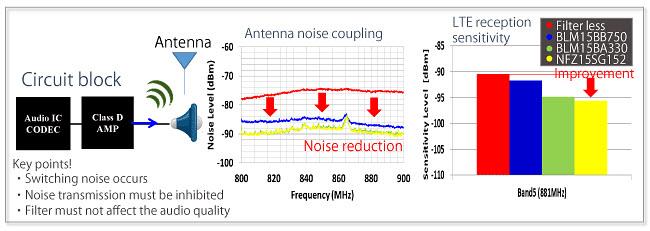
Filterless Class D amplifiers are used to amplify the audio signal in smartphones. These filterless Class D amplifiers do not require an LC filter for audio demodulation, which allows them to be arranged in a small-scale circuit that connects the amp and the speaker. However, processes that amplify the signal generate switching noise, which is emitted into the surrounding space, and also cause a loss of reception sensitivity through coupling with its own antenna.
Because this creates noise, Murata wanted to use a different type of amplifier. But the filterless Class D amplifiers are essential due to their miniature size and superior efficiency, which make it possible to reduce smartphone power consumption.
Figure 2 (below) shows an example in which noise has coupled (interfered) with the antenna. High levels of noise can be seen within the cellular band.
Using Murata's NFZ15SG audio line noise filter reduces the noise level and improves the reception sensitivity, depending on the reduced level. The newly developed NFZ series possesses superior impedance characteristics in the cellular band and are effective for improving reception sensitivity.
Figure 2
Block diagram of a smartphone audio circuit
Speaker, earphone isolation countermeasures
In order for the antenna to efficiently emit radio waves, the antenna itself must be separate. However, in practice, electronic circuits are integrated with and configured around the antenna, degrading the characteristics of the antenna.
The following two methods can be considered as countermeasures.
1. Physically separate the audio circuit from the antenna.
2. Electrically separate the two elements (isolation).
Because of the increasing circuit density of smartphones in recent years, method 1 is difficult to adopt. This means the components must be electrically isolated, as in method 2.
In order to achieve isolation, it is vital to increase the impedance of the integrated pathways or the circuit junction to make it seem as if the circuits are not connected at all.
Figure 3 (below) shows an example of applying such a countermeasure to the earphone junction. (The measurement result TRP indicates the magnitude of the power radiated by the antenna.)
Using a high impedance audio line noise filter (NFZ or LQW series) in the cellular band provides isolation and improves the efficiency of radio wave emission compared to the antenna without the countermeasures.
Figure 3

An example of countermeasures for the earphone junction
Microphone TDMA countermeasures
Because the sound picked up by the microphone is subtle, it is amplified by the low noise amplifier (LNA) built into the codec and detected as sound. The LNA receiver typically offers high impedance, which means RF signal interference from wireless communication is detected as a large voltage.
In particular, RF signals are detected in the voice band during GSM communication. This can cause a buzzing noise to occur in the caller’s speaker and receiver as well as in the receiver of the other party (keyed carrier noise). This is a characteristic of the method used in GSM communication. Because the standard specifies power emissions as high as 33dBm at 4.6ms intervals, the 217Hz frequency component is heard as sound. Therefore, countermeasures for this problem are still needed around the world.
In this countermeasure, a filter with high impedance in the communication band that does not affect the sound is an ideal way to prevent RF signal interference.
As shown in Figure 4 (below), a large spectrum of noise is detected in the audible range (20Hz to 20kHz) when a filter is not inserted, while the use of an NFZ15SG audio line filter is able to significantly reduce the noise level.
Figure 4

Noise reduced by using an audio line filter
Audio line filter item list
As explained above, it is important to avoid degrading audio quality while satisfying the target characteristics for noise level and reception sensitivity in audio line noise and isolation countermeasures.
In order to satisfy both requirements, Murata offers the NFZ and LQW series of audio line noise filters.
Adopting these audio line countermeasure components allows manufacturers to design smartphones equipped with miniature, high-quality audio circuits.
SimSurfing Tool

Murata SimSurfing Tool
A free website design tool that provides information and data for selecting electronic components.
Community Forum
Murata Community Forum provides searchable content with various discussion topics, popular blogs, and articles. The Murata broad market support team holds regular reviews to discuss open issues, allowing inquiries to be answered in a timely manner. The forum content is freely accessible to the public. However, users must log in to post questions or answers. Registration is free of charge.
Learn More
Murata EMI Noise Suppression
Provides engineers with complete support, including products & design-simulation software solutions.
Related Products

Murata Electronics NFZ Chip Noise Filters
Designed to suppress the noise of audio lines such as Class D amplifier, low DC resistance.

Murata Electronics LQW Wirewound Type Inductors
Offers a high Q value, giving them ideal attenuation characteristics inside the passband of filters.