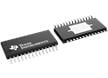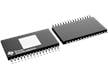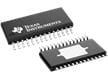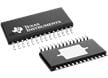


TAS5815PWPR

Texas Instruments
595-TAS5815PWPR
TAS5815PWPR

Mfr.:

Description:
Audio Amplifiers 30-W stereo 60-W mo no digital-input hi

Lifecycle:
New Product:
New from this manufacturer.
ECAD Model:
Download the free Library Loader to convert this file for your ECAD Tool. Learn more about the ECAD Model.

In Stock: 1.741

Stock:
1.741 Can Dispatch Immediately
Factory Lead Time:
12 Weeks Estimated factory production time for quantities greater than shown.
Minimum: 1   Multiples: 1
Unit Price:
-,-- €
Ext. Price:
-,-- €
Est. Tariff:

Pricing (EUR)

Qty. Unit Price
Ext. Price
3,40 € 3,40 €
2,24 € 22,40 €
2,05 € 51,25 €
1,74 € 174,00 €
1,64 € 410,00 €
1,48 € 740,00 €
1,26 € 1.260,00 €
Full Reel (Order in multiples of 2000)
1,21 € 2.420,00 €
1,19 € 4.760,00 €

Product Attribute Attribute Value Select Attribute
Texas Instruments
Product Category: Audio Amplifiers
RoHS:  
Class-D
48 W
0.03 %
HTSSOP-28
4.5 V
26.4 V
- 25 C
+ 85 C
SMD/SMT
TAS5815
Reel
Cut Tape
3 dB Bandwidth: 175 kHz
Brand: Texas Instruments
Development Kit: TAS5815EVM
Moisture Sensitive: Yes
Product: Audio Amplifiers
Product Type: Audio Amplifiers
Shutdown: Shutdown
Factory Pack Quantity: 2000
Subcategory: Audio ICs
Type: Class-D Audio Amplifier
Vos - Input Offset Voltage: 6.5 mV
Products found:
To show similar products, select at least one checkbox
Select at least one checkbox above to show similar products in this category.
Attributes selected: 0

This functionality requires JavaScript to be enabled.

CAHTS:
8542330000
USHTS:
8542330001
MXHTS:
8542330299
ECCN:
EAR99

TAS5815 Stereo Class-D Audio Amplifier

Texas Instruments TAS5815 Stereo Class-D Audio Amplifier is a high-efficiency digital input Class-D audio amplifier with an integrated audio processor with up to 96kHz architecture. It includes adaptive modulation schemes based on output power and low RDS(on)= 120mΩ. It also supports the DPEQ process for easy tuning. The DPEQ is used to mix the audio signals through two signal paths (low level and high level). These two paths are used with separate equalization properties. A third path monitors the incoming audio and determines these two parts' thresholds and mixing characteristics. Thus, the mix between the two high- and low-level channels is dynamic and depends on the incoming audio.